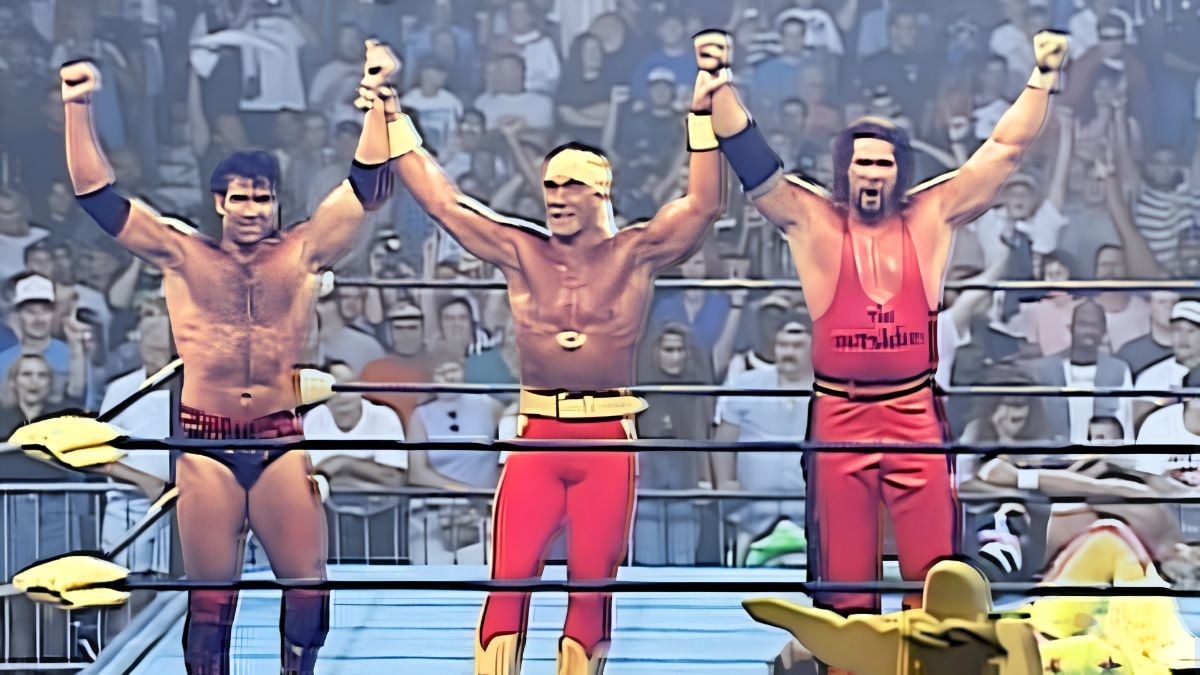
Thirty years ago, Hulk Hogan did the unthinkable. At WCW Bash at the Beach 1996, the ultimate red-and-yellow hero dropped Randy Savage, aligned with Scott Hall and Kevin Nash, and revealed himself as the third man in the New World Order, one of wrestling’s most seismic transformations.
The moment has been dissected endlessly, but its anniversary lands differently following Hogan’s passing. Eric Bischoff recently admitted he still finds it hard to accept that Hogan is gone, saying it feels both like “forever” and “five minutes ago” since the group’s defining era. That emotion is inseparable from revisiting the footage now: the leg drop, the debris raining into the ring, the venom in Hogan’s first “Hollywood” promo.
It worked because it was not simply a turn. It was a collision of timing, talent, cultural mood and a willing participant whose image was big enough to make betrayal feel impossible.
Bischoff has said Sting was the contingency choice if Hogan backed out, but acknowledged it would not have been as big; Nash likely would have assumed the lead role. Kevin Nash has since made clear just how much reverence the Outsiders had for Hogan, saying, “Everybody’s a mark for f***ing Hulk.”
John Cena’s 2025 heel turn offered a recent comparison, and ultimately a reminder of the distinction. The initial shock was enormous, but the run lost momentum; Cena himself later said, “I flopped out there.” A great reveal can start a story, but it cannot replace the alignment of conviction, continuity and consequence that made the nWo feel like a hostile takeover.
Hollywood Hogan and the nWo remain etched in the annals of wrestling history. Thirty years later, the industry is still waiting to feel something that big again.
Voices on Hogan’s Turn
“I wasn’t 100% sure that Hulk was going to follow through until he literally showed up to the building. I was nervous as hell, right up until he showed up and said, ‘Let’s do this, brother.’” — Eric Bischoff, on the uncertainty surrounding the reveal.
“It felt real because it was treated real.” — Bischoff, on why Hall and Nash’s arrival, followed by Hogan’s betrayal, connected so powerfully with viewers.
“We knew we definitely had some heat in that building. But we didn’t know if it would transcend any further than that night.” — Kevin Nash, reflecting on the immediate crowd response.
“There isn’t a person on this f***ing planet that had an idea it would be a tenth of what this thing turned out to be 25 years later.” — Nash, on the lasting scale of the nWo’s impact.
“The nWo changed the business. They made it possible for heels to be cool.” — Paul Wight, who later joined the faction as The Giant.
“The reaction of the crowd that night of the pay-per-view told us something different was happening. The anti-hero became the hero.” — Wight, describing the cultural shift that followed Hogan’s turn.
“I didn’t want it to feel like we were shooting on a movie set. I wanted that lack of pre-production feel. We wanted the viewer to feel like it was out of control.” — Bischoff, on the raw presentation of the angle.
“Hulk Hogan, you can go to hell!” — Tony Schiavone, delivering the defining sign-off as Bash at the Beach went off the air; Schiavone later said he felt compelled to react as a fan watching Hogan betray the audience that had supported him for years.