Jeremy Ganger’s retirement match is scheduled for Saturday at Wrestling Revolver: Revolver Strong, at the Calumet Center in Dayton, Ohio.
When Ganger walks to the ring, embedded in his leg is a piece of shrapnel. A reminder of the night his life and that of a city upended into a national tragedy.
He received the injury when a gunman killed nine people and injured 27 others in Dayton’s Oregon District in 2019. Ganger was working as a bouncer at a local club called Ned Pepper’s when it occurred. Where he saved dozens of lives with his quick thinking and courageous actions.
Police were getting ready to question him when an officer noticed he was bleeding from the leg. Ganger had been hit during the shooting, but was so busy rushing people to safety, he hadn’t noticed. He was taken to hospital.
“I refuse to get it taken out,” Ganger said. “It’s my way of remembering the nine people we lost that night.”
Ganger knew six of the nine who died. If he wasn’t there that night, it would have been dozens more.
August 4, 2019
After having dinner with a friend, Ganger went to work at Ned Pepper’s, checking ID’s outside the front door. An experienced bouncer, Ganger knew most of the customers and the people who frequented Dayton’s Oregon District. He recalled the area as one big family, one he’s always happy to visit.
As he worked outside, he heard a gunshot down the street. Ganger, who grew up in rural Miami County, knew the sound of a rifle being fired.
When the second shot fired, Ganger saw the shooter coming from an alley.
“We saw people running from the Blind Bob’s area,” Ganger said. “I was yelling and freaking out like everyone else. I saw the shooter coming down the street and the muzzle of his gun lighting up.”
Ganger said staffers at Ned Pepper’s, Blind Bob’s and other clubs in the district had active shooter training at the time. Ganger began yelling for people to run into the bar and began guiding them in as people began falling from the gunfire.
Security camera video of the shooting showed Ganger guiding dozens of people in through the door of the club and clearing the patio as fast as he could. He kept standing outside the door as the gunman approached.
The gunman was carrying a rifle with a 100-round drum magazine. He was wearing Kevlar and a tactical helmet. Law enforcement reports later stated he had substances in his system.
Dozens of people began hiding behind the bar at the back of the building. Many of the male staffers dropped down to cover female staffers. Reports said as many as 300 people had fled into Ned Pepper’s for protection.
The club had two doors at the entrance. Ganger locked and shut the first as the gunman approached.
“My thought was to get everyone safe,” Ganger said. “And he wasn’t getting into the building no matter what.”
The gunman paused, long enough for Dayton police officers to shoot and kill him. Officers wearing summer gear were armed only with handguns and had fired dozens of rounds at the gunman before he fell. The autopsy report said he was shot 30 times.
Ganger, not knowing if the shooter was dead, grabbed his weapon as police entered and swept the building. People began running out of the other restaurants and clubs, tending to victims with towels, performing CPR and helping anyway they could.
As Ganger saw people tending to the wounded, he glanced at the door he was standing in front of as he ushered dozens to safety. It was riddled with bullet holes.
In less than 30 seconds, nine people were dead, 17 others had been shot and 10 more suffered injuries related to the shooting. Dayton police officers responded, killing the shooter, in just seconds. Among those on the scene that night were staffers from a local professional baseball team, the daughter of a U.S. Congressman and hundreds of others whose lives changed in less than half a minute.
A wrestling fan turned wrestler
Ganger began wrestling in the early 2000s. He worked local independents before meeting Cody Hawk, a long-time trainer and later owner of the Heartland Wrestling Association. The HWA was a developmental territory for both WCW and WWE during the Monday night era and was founded by Les Thatcher, considered by many to be the among the best trainers in the world.
Thatcher sold the company to Hawk. Hawk trained former WWE, AEW and IWGP champion Jon Moxley and trained Ganger, who discovered there were advantages to having a third-shift job as a wrestler.
”My roommate at the time was Sami Callahan,” Ganger said. “I was working later and that allowed me to get a lot of one-on-one time with Cody in the daytime when it wasn’t busy. He took me under his wing.”
Ohio’s competitive independent scene didn’t keep wrestlers from helping each other. Ganger said he was surprised at how veterans and more established stars were always generous with their time, showing him the ropes.
He recalled Shaun Ricker, who wrestles as LA Knight in the WWE, being especially helpful, along with Nigel McGuinness and Moxley.
“Those one-on-one sessions were amazing for me,” Ganger said.
Ganger, a fan of Mick Foley as a kid, adopted the death match style after working with Alex Colon, a friend he would task with being his opponent in his retirement match. He was highly influenced by Callihan, his former roommate and friend, who will be at Saturday’s show. He considers Callihan to be family.
”Since he introduced me to wrestling, I really wanted (my final opponent) to be Sami,” Ganger said. “But wrestling Alex means so much.”
After the shooting
Most of the victims of the shooting were taken to Grandview Medical Center, blocks from the Oregon District. Many walked there.
In his teens, Ganger was told by doctors that he had epilepsy. One of the triggers for seizures was stress. After arriving at the hospital, he had several seizures and was sedated by physicians. He slept for two days after the shooting.
When he was released by doctors, he demanded to be taken to Ned Pepper’s before going home. He hobbled into the bar on crutches and was greeted by the staff, all of whom survived.
The shooting sparked a decline in his mental health. Ganger couldn’t stand crowds. When he did venture out in public, he would see visions of the shooter in crowds. He was invited by All Elite Wrestling to be a special guest at its inaugural Double or Nothing pay-per-view, but the ordeal presented by his mental health kept him from attending.
”It changed my life dramatically,” Ganger said. “I had PTSD, I didn’t sleep well.”
Tragedy sparks new mission, career
Since the shooting, Ganger became a mental health counselor and a caseworker. He was diagnosed with superior survivor’s guilt. While Ganger saved dozens, the loss of those who were killed were too much for him to bear. One woman, who was killed in front of him on the patio of the bar, was staring at him the moment she was shot. They were friends.
Ganger said his interactions were mixed. With the press, reporters were friendly and showed appreciation for his actions . He recalled one reporter telling him how grateful he was he lived in the same community as Ganger.
Other interactions weren’t so friendly. He often received social media messages blaming him for not saving a relative or friend. People in public would criticize him for how he handled the situation.
What kept his hopes up the most was messages he received from military members and law enforcement. Officers from Las Vegas and Virginia, who responded to mass shootings, praised Ganger for his quick thinking and bravery. Military members who had returned from deployment also thanked him for what he did for the city.
In his darkest moments he became suicidal, dealing with PTSD, survivor’s guilt and depression, even as he took classes to become a counselor. What turned his life around was the birth of his 5-year-old daughter.
”My daughter, she’s 5 and she saved my life,” Ganger said. “I was told I could never have kids, and here I am, at 42 years old, having a daughter. She saved me.”
Ganger kept receiving calls and voice mails from people saying they worked for NXT, World Wrestling Entertainment’s then developmental brand. Still wrestling, Ganger dismissed the calls as ribs from fellow wrestlers. He found out later one of the calls was from Paul Levesque.
“Sami (Callihan) called me,” Ganger said. “He just says, ‘Pick up your phone. It’s real, dude.”
In a better place mentally by that time, Ganger made the trip to Florida with a friend who was a nurse. After missing a chance to see AEW, he was determined to make it to NXT.
”When AEW contacted me to come to Chicago, it was too much for me, the crowd was too much for me,” Ganger said. “I felt horrible about it. I wish I could have went. I just wasn’t in the right mental state.”
Over a couple days, Ganger was shown the WWE Performance Center.
He walked backstage before a taping and saw Tommaso Ciampa talking with a group of wrestlers and staffers. Ciampa saw Ganger, walked up to him and grabbed him in a bear hug. He called Ganger, “Mr. Hero”, and then introduced him to everyone there.
Ganger said Ciampa’s embrace and warm greeting was the highlight of his trip.
”That gentleman made me feel so awesome,” Ganger said.
Ganger was interviewed with Paul Levesque, who ran NXT at the time. He was invited backstage to watch the show with NXT staffers Shawn Michaels, Jeremy Borash and Brian “Road Dogg” Armstrong.
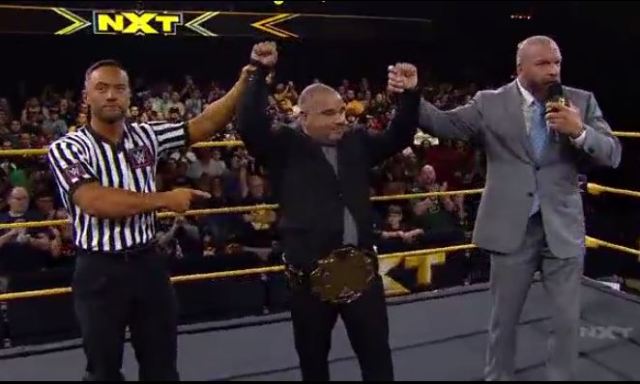
Levesque entered the ring before the taping was set to begin. He gave a speech while the screen showed news clips of the Oregon District shooting and interview footage of Ganger.
Ganger, confused, turned to Borash, who told him, “We forgot to tell you, but you’re going to the ring.”
Levesque introduced Ganger as “one of their own,” a professional wrestler. Ganger went down to the ring and climbed the steps to the apron. Levesque mentioned, “Hey, you even remembered to wipe your feet.”
Ganger was presented with an NXT title belt. Video of the presentation was put on WWE’s website and made news across the country.
Before the presentation ended, Levesque grabbed Ganger for a private conversation.
“It was touching,” Ganger said. “He told me he loved me and respected me. It was a private moment.”
Most of the NXT staffers didn’t know why Ganger was at the event until the presentation. When he reached the back, he was immediately grabbed by Michaels. who
Michaels took him outside with a rosary in his hand and grabbed Ganger’s and began praying for him.
Weeks later, Mick Foley was on tour and was scheduled for an appearance at a Dayton-area comedy club. Ganger received an invite from Foley, one of his biggest inspirations. Foley wanted to talk to him personally.
”He told me, what you did that night was tremendous not just for the people there but for the wrestling world,” Ganger said. “We get so much bad advertising because people think all wrestlers are scumbags. You showed we are people. And we can do tremendous things. You’ve done so much.”
Ganger has revisited the shooting regularly. After years of dealing with the after effects he said his one regret was not reaching out to someone sooner, “Or just talked to someone.”
He tried handling the emotions and the mental toll like traditional men were taught – by bottling it up. Later, he was overwhelmed with thoughts of suicide. He said that was a mistake. Ganger said anyone who suffers a traumatic event should seek help or counseling immediately.
”I needed help a lot sooner than later,” Ganger said. “I wish I had talked about what was going on, but I was a traditional man and we are taught to keep our feelings to ourselves. I wouldn’t have been suicidal, I wouldn’t have talked about taking my own life. I wish I had asked for help sooner.”
Ganger said one source of help was surprising – the wrestling business. Whether it was his friends he wrestled with for 20 years in Ohio or stars in other states and on national TV, the business he gave his blood and body to gave back when he needed it most.